Your next customer might find you while searching Google, comparing businesses on Google Maps, or asking an AI tool for a recommendation. Someone else might hear your name from a friend, then look you up before deciding whether to call.
Each person takes a slightly different route. Your business needs to make sense wherever they land.
If you’re wondering how to get your business found online, start with the information people need to choose you: what you do, whom you help, where you work, and why they should trust you.
A thoughtful local SEO strategy brings those details together. It helps potential customers find useful answers and gives search engines clearer information about your business. It also creates a stronger foundation as AI answers become part of the discovery process.
You can’t control every search result. You can control the quality, accuracy, and usefulness of the information you put into the world.

Local Search Has More Than One Front Door
Think about someone looking for an HVAC contractor in Marietta.
They might type “AC repair near me” into Google Search. They might open Google Maps and compare nearby businesses. They might ask an AI tool, “Who handles HVAC replacement for older homes around East Cobb?”
Those searches share local intent: the person wants help from a business that serves a particular place.
Local searches can lead to several kinds of results:
The local pack: the map and nearby business listings shown within some Google search results.
Google Maps: a place to explore locations, reviews, photos, and business details.
Organic search results: links to websites, service pages, articles, and other relevant content.
AI answers: generated responses that may summarize information and link to supporting sources.
Local SEO helps you build a presence across relevant local search results. Your website, business profile, reputation, and local connections all deserve attention.
For small businesses, that means looking beyond one ranking and asking a better question: Can the right person find enough reliable information to take the next step?
Why Is Local SEO Important for Small Businesses?
Local SEO is search engine optimization focused on helping people discover relevant businesses in a specific geographic area. For small businesses, that connects your online presence with the places and people you actually serve.
Local customers searching for an emergency repair have different needs from someone researching a project for next year. Both searches have local intent, but the information each person needs will differ.
A useful local SEO strategy accounts for those differences. Your emergency service page should explain availability and how to contact you. A planning article can explain options, timelines, and questions to ask.
This is how local SEO becomes part of the customer experience. You help local searchers understand whether your business fits their needs before they pick up the phone.
The goal is to attract customers whose needs match your services. More local customers finding the right information is more valuable than unrelated visits from people you cannot serve.
Start With a Google Business Profile That Reflects Your Business
Your Google Business Profile may be someone’s first introduction to your company. Treat it with the same care you would give your storefront or reception area.
Review your business category, contact information, website link, services, and business hours. Include holiday hours so nearby customers don’t arrive at a locked door.
Choose a primary business category that accurately describes your main work. Use the business description to explain your services clearly. Add photos that help people recognize your location, understand your work, or feel comfortable visiting.
Google says complete, accurate business information can help a business appear in relevant local search results. Its local rankings consider relevance, distance, and prominence—how well the business matches the search, how close it is, and how well known it is.
That distance factor matters. A Google Business Profile update cannot move your office closer to every customer.
What you can do is make your business profile useful and keep it current. Check it after a move, a phone change, a new service launch, or a shift in your schedule.
Local SEO work includes those ordinary details. They matter to the person trying to reach you.
Give Your Website Something Useful to Say
A beautiful website can still leave potential customers with unanswered questions.
Do you offer the service they need? Do you serve their local area? What happens at the first appointment? How do they request a quote?
Your website should answer those questions in language your target audience understands.
For example, a page titled “Our Solutions” could mean almost anything. A page explaining “Commercial HVAC Replacement for Occupied Apartment Communities” gives visitors a much clearer starting point.
Build your local SEO strategy around your actual services and customers:
Explain your main services on focused pages.
Describe the communities and locations you genuinely serve.
Answer questions you hear during calls and consultations.
Make your phone number, contact form, or booking link easy to find.
Check that pages work comfortably on a phone.
Use relevant keywords where they fit naturally. A local keyword usually connects a service with a location or a nearby need, such as “powder brows in Acworth” or “emergency AC repair.”
A keyword research tool can help you explore phrasing. Your customer conversations help you understand what those searches mean.
Local SEO works best when the page delivers on the promise that brought someone there.
Make Titles and Descriptions Specific
Page titles and meta descriptions deserve attention, too.
Write a title that identifies the page’s subject. Use meta descriptions to offer a clear, accurate preview of what visitors will find. Google may use a meta description for the search snippet, although it can choose text from the page instead.
Think of these details as an invitation. Once someone clicks, the page needs to follow through.
Choose Local Keywords Around Real Customer Questions
Start your local keyword research with the questions customers ask before hiring you.
What do they call the problem? Which service do they need? Does urgency, property type, or location change the answer?
For example, “HVAC contractor” is broad. “Emergency AC repair in Marietta” expresses urgency and local intent. “HVAC replacement for apartment communities” identifies a particular customer and project.
Use Google Autocomplete to explore possible wording for local searches. Its predictions draw partly on real searches, making it a useful starting point for ideas. Predictions are not search-volume measurements.
Google Keyword Planner provides estimated monthly searches, and its location settings can help you research a local area. Use a keyword research tool to inform your choices, then check whether each phrase fits your target audience and services.
For each promising local keyword, ask:
What does this person need?
Which existing page should answer that need?
What useful information is missing?
What should the visitor do next?
Avoid creating nearly identical pages with a different town name pasted into each one. Give location pages a clear purpose and information specific to that location.
Effective local SEO connects local searches with useful answers. Repeating a phrase cannot compensate for a page that leaves the customer confused.
Keep Your Local Listings Accurate
An old phone number can cost you an inquiry. An outdated address can send someone across town.

Start by checking your name, address and phone number across your website, Google Business Profile, and the directories your customers are likely to use.
Local citations are online mentions of your business information. They may appear in business directories, local directories, professional associations, or community websites.
For your local SEO efforts, prioritize useful, relevant listings rather than collecting directory listings simply to reach a number.
Depending on your business, that could include:
Your chamber of commerce.
An industry association.
A trusted professional directory.
A local organization where you hold membership.
Established online directories your customers actually consult.
Check key directories after changes to your business details. Make sure each listing points to the correct website and location.
Accurate local business listings help people reach you. That alone makes maintaining them worthwhile.
Understand What Your Local Citations Actually Contain
Local citations generally fall into two categories.
Structured citations present business details in labeled fields, such as the name, address and phone number in online directories. Unstructured citations mention those details within an article, event page, or another website’s content.
For your local SEO checklist, review both the accuracy of the information and the usefulness of the source.
A chamber membership page may help people discover your business online. An outdated listing with the wrong address and phone number creates an obstacle instead.
Prioritize local directories, industry resources, and online directories that make sense for your customers. A business that serves homeowners will have different listing priorities from a specialized business consultant.
Local SEO does not require your business to appear in every directory. It requires judgment about where people look and what information they find.
Build a Review Process You Can Keep Up With
Online reviews give potential customers a glimpse of other people’s experiences.

A review describing clear communication, a helpful explanation, or a well-managed project offers more context than a star rating alone.
Make requesting feedback part of your normal process. Encourage customers to share an honest review after a suitable point in their experience. Avoid incentives, pressure, or asking only people you expect to leave positive reviews.
Google identifies review quantity and positive ratings as factors that can help local search rankings. Reviews also give you an opportunity to listen and respond.
Negative reviews need a thoughtful response. Acknowledge the concern, stay professional, and offer an appropriate way to continue the conversation privately.
For healthcare practices, a public reply should protect privacy and avoid confirming a patient relationship.
Your local SEO strategy should include time to monitor feedback. More reviews create more opportunities to learn what customers value and where the experience needs attention.
What Changes When AI Answers Enter the Picture?
AI search adds another place where someone may encounter your business.
A person can ask a detailed question, compare options, and refine what they need through follow-up questions. An answer may include business names, summaries, and links.
The important distinction is that AI tools do not all use the same sources or produce the same recommendations. A mention in one answer does not establish consistent visibility across every platform.
For Google’s AI search features, Google says established SEO practices remain relevant. Helpful content, accessible pages, internal links, and accurate information continue to matter. Following those practices does not guarantee inclusion.
For local businesses, a sensible approach is to make your expertise easier to understand and verify:
Explain who provides your services and what qualifies them.
Describe services, limitations, and service areas accurately.
Publish useful answers to specific customer questions.
Update information when your business changes.
Support factual claims with appropriate evidence.
These are practical editorial priorities. They are not a promise that an AI tool will recommend your business.
At Unstoppable Start Studios, we see local SEO and AI visibility as connected parts of a broader marketing strategy. Both require attention to the information customers encounter, along with a willingness to check what platforms are actually showing.
Let Your Community Connections Show
Your local presence extends beyond your website.
Participating in local events, collaborating with other local businesses, and supporting organizations can introduce you to people who may need your services.
Sponsoring local events can also create opportunities for relevant mentions or links on other websites. Choose involvement that fits your business and your local community.
A florist might contribute to a neighborhood home tour. A contractor might share expertise with a property management association. A wellness practice might participate in an educational event.
When you’re involved, document it. Share useful photos, explain your contribution, and help people find the event or organization.
Local marketing becomes more meaningful when it reflects relationships you actually maintain.
Look Beyond a Single Ranking Screenshot
It is tempting to search for your company, check its position, and treat that result as your local SEO report.
That gives you one view of your business’s visibility.
The local pack and organic search results are different placements on search engine results pages. A business can appear in the local pack for one search while a service page appears in organic search results for another.
Google identifies relevance, distance, and prominence as major factors in local search rankings. That means your location relative to the searcher affects the opportunity to appear.
A useful local SEO review asks several questions:
Does your Google Business Profile describe your services accurately?
Which local searches bring people to your website?
Where do competitors appear in the local pack?
Are your local search rankings improving for services you want to grow?
Do those changes correspond with qualified inquiries?
Local SEO rankings provide context. They do not tell the entire story of whether your marketing is working.
Use Local SEO Tools to Investigate
Choose local SEO tools around the questions you need to answer.
Google Search Console helps you investigate search queries and website performance. Business profile reporting helps you review interactions with your listing. Analytics and inquiry records help you examine what happens afterward.
Other local SEO tools can help you review listings or compare local rankings across locations. Understand what each report measures before drawing conclusions.
If your business appears prominently in the local pack but inquiries remain weak, investigate the offer, customer experience, and contact process. If important service pages receive little local traffic, review the content and how people reach those pages.
Local SEO improves through that combination of observation, action, and follow-up.
Measure What Happens After People Find You
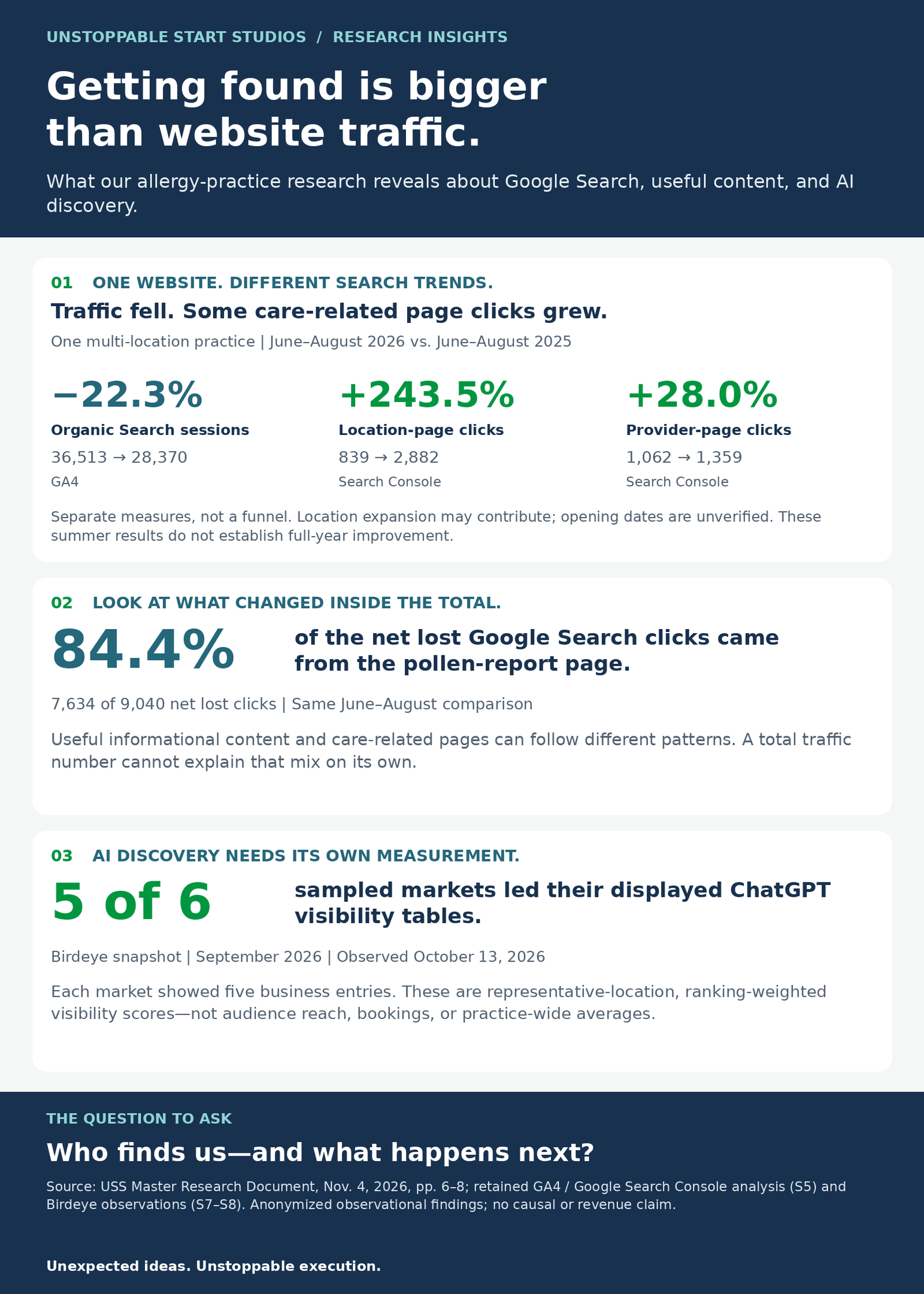
Local search visibility is useful. You also need to understand whether it leads to the outcomes your business needs.
Google Search Console can help you review the queries and pages generating impressions and clicks in Google Search. Website analytics, business profile reporting, and your inquiry records add other pieces of the picture.
For your local SEO work, consider tracking:
Visits to important service and location pages.
Completed contact forms or booking requests.
Calls and qualified inquiries, where tracking is available.
Business profile interactions.
The services and locations associated with new business.
Be precise about what each measurement tells you. A click on an appointment button is not necessarily a completed appointment. A request for directions does not confirm a visit.
Ask new customers how they heard about you, too. Their answers can reveal connections that a reporting dashboard misses.
The purpose of local SEO is to help relevant people discover your business and move toward a useful next step. Reporting should help you judge that progress.
Make Discovery and Contact Work Together
Someone finds your business on a phone, opens the website, and tries to contact you. What happens next?
As part of your local SEO review, test that experience yourself. Read a service page, tap the phone number, complete the contact form, and check the confirmation message. Look for small text, awkward menus, broken links, or forms that ask for too much.
Your local SEO efforts should help attract customers and give them a clear path forward.
Apply the same care to online reviews. Invite satisfied customers to share honest feedback through a consistent process that welcomes everyone’s experience. Read positive reviews for clues about what customers value. Treat negative reviews as an opportunity to identify concerns and respond professionally.
Getting more reviews is only one part of the work. Learning from online reviews can help you improve the experience future customers receive.
Social content, email, and paid advertising can support your local SEO strategy, too. Use them with a clear purpose: introduce your work, answer questions, maintain relationships, or promote a relevant service.
Keep your Google Business Profile, website, and campaign messages aligned. People should recognize the same business and understand the same offer wherever they find you.
That consistency gives local customers fewer obstacles between discovering you and deciding to reach out.
A Manageable Place to Start
You don’t need to tackle every local SEO task this week.
Start with these five:
Review your Google Business Profile. Check the category, services, contact details, photos, and hours.
Check your most important service pages. Can a new visitor understand what you offer and how to contact you?
Verify your main local listings. Correct outdated names, addresses, phone numbers, and links.
Establish a review routine. Request honest feedback and make time to respond appropriately.
Choose meaningful measurements. Connect local search activity with inquiries and business outcomes wherever possible.
Then make maintenance part of your schedule. Local SEO needs ongoing attention as services, locations, customer questions, and search experiences change.
Make It Easier for the Right People to Choose You
You already have a business to run. Keeping up with local search results, Google Maps, website content, reviews, and AI answers can feel like another job.
That is where a coordinated local marketing strategy helps.
Unstoppable Start Studios brings strategy, websites, content, SEO, and ongoing marketing execution together. We help you identify what needs attention, set priorities, and keep the work moving.
If your online presence hasn’t kept pace with your business, let’s start there.
Unexpected ideas. Unstoppable execution.
Sources & further reading
- Google Business Profile: Tips to improve your local ranking
- Google Search Central: AI features and your website
- Google Search Central: Search snippets and meta descriptions
- Google Search: How autocomplete predictions work
- Google Ads: Use Keyword Planner
- USS: Beyond the Traffic Report—research and limitations